
 Українська
 Русский
 Português (Brasil)
 Deutsch

- Bodies are physical: a soldier down has to get back up.
- Every live soldier costs continuous PhysX work plus AI.
- Position beats aim — buying recovery time is the cheapest effect.
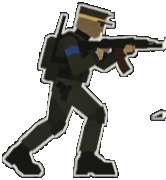
The official game page states the focus of DummyWar plainly: active ragdoll physics, AI behaviour and dynamic combat interactions. A character in this game is not an animation playing on top of a hitbox. It is a physical body that reacts to movement, impacts, injuries and the ground it stands on — and that single fact explains most of the game’s behaviour.
Version: the balance and animation improvements below are documented in the 0.0.3 and 0.0.5 PC release notes and on the developer’s game page. The build embedded on this site identifies as 0.0.4.
What active ragdoll actually means
The developer’s own description of the feature is that characters physically react to movement, impacts, injuries and their surroundings. The AI soldiers, in turn, engage enemies, search for cover, react to incoming fire and attempt to recover their balance after being hit.
That last clause is the useful one. A bot that is knocked down is a body that has to get back up, and a body getting back up is a body not shooting at you. This is why positioning beats aim in a sandbox where both sides are pulled by the same rules.
Balance, trips and what 0.0.5 fixed
Balance has been the recurring problem. In the 0.0.3 notes the developer says walking and running are based on motion capture layered over the physics body, that movement looks more natural as a result, and that characters trip over uneven ground far less often. The same release also fixed characters falling less often when they caught their feet on uneven ground, and stopped a character’s head twitching after death.
The 0.0.5 release tightened the same area again. The developer says the Active Ragdoll system now makes movement more stable, natural and predictable, and that previously characters could sometimes lose their balance because of minor obstacles such as small rocks or uneven terrain — a situation whose likelihood has been significantly reduced. The same update reworked the hand bone system and weapon interactions, fixing incorrect hand positioning, unnatural arm movements and the infamous “detached hands” effect.
Read that as a trend rather than a single patch: each release makes bodies more reliable, and the version you play may behave differently from the next one.
The animation layer and the switch in Settings
Motion capture is layered over the physics body, and the developer states that this can be disabled in the settings. That is worth knowing if you are chasing a specific behaviour: turning it off changes how soldiers move without changing how they react.
The planned work list on the official page names the same direction — smoother, more natural movement, aiming and physical interactions, and better physical reactions that refine active ragdoll physics, balance, hit reactions and interactions between characters.
What every soldier costs
This is where physics stops being a toy and starts being a budget. In the 0.0.5 notes the developer is explicit that the demanding part of the game is not the graphics but the complexity of the physics simulations handled by NVIDIA PhysX within Unity, combined with the large number of AI calculations happening at the same time. Each character uses a complex physical model that requires continuous calculations, and when large numbers of soldiers are on the battlefield the computational load increases significantly.
The optimisation work between versions has been substantial: glass shattering is now many times lighter on performance, explosions and scorch marks on the ground are about ten times cheaper, and AI vision and pathfinding calculations have been lightened.
How to fight the physics
- Position beats aim. A soldier pushed off a ledge, shot off a wall or caught in an explosion is a body that has to get up again. Buying that time is the cheapest effect in the game.
- Cover is physical, not statistical. A wall stops a body as well as a bullet, and a body that has to climb or crawl around an obstacle is a body that is late.
- Watch the ground, not just the enemy. Uneven terrain is part of the fight. A route that crosses broken ground costs more than its distance suggests.
- Count bodies, not shooters. A squad that is half standing and half recovering is half a squad, whatever its roster says.
- Keep the roster small. Every live soldier is a continuous physics calculation plus AI work. Fewer soldiers is both a frame-rate decision and a tactics decision.
What is still being worked on
The official page lists the open items without dressing them up: helping wounded soldiers during combat, dragging and carrying injured teammates, improving AI decision-making and cover behaviour, expanding the damage and injury systems, and adding more weapons, environments and character models. None of that is finished, and the developer says the project is in a very early stage.
Read Performance and Settings for the tuning side of the same problem, and Soldier Classes for what the different bodies in a roster are actually for.