
 Українська
 Русский
 Português (Brasil)
 Deutsch
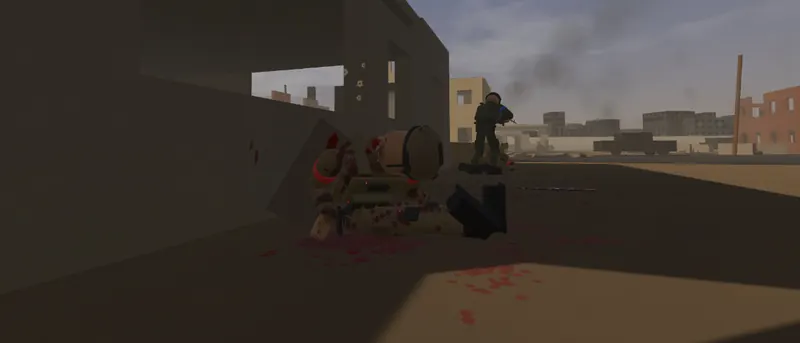
- Armour is worked into penetration and damage, not added on top.
- Helmets improve survival odds; head and vital hits can kill almost instantly.
- Measure the system in your own build — the developer publishes no damage numbers.
Version 0.0.5 reworked how bullets meet bodies. The developer says the ballistic system, the bullet impacts and the shooting effects were all improved, and that special attention went into how bullets interact with protective equipment and character bodies. In practice that means one exchange between two soldiers can now end in three different ways, and your equipment changes the odds.
Version: the reworked ballistics, armour handling and critical hit system are documented in the 0.0.5 PC release. The build embedded on this site identifies as 0.0.4, so it runs the earlier damage model. Read the guide for the reasoning, then confirm the numbers in your own build.
Armour is calculated, not decorative
The 0.0.5 notes are explicit about the model: body armour is taken into account when calculating bullet penetration and damage, and protective gear plays a more significant role in combat than it did before. The developer also states that a helmet can improve a soldier’s chances of survival in certain situations.
The wording matters. This is not a flat damage reduction bolted onto a soldier — the bullet is evaluated against what the round can get through. That is why the same shot can produce very different outcomes depending on what the target is wearing.
Armour against vehicles is a separate rule
One rule about armour is older and worth keeping straight. In the 0.0.3 release notes the developer writes that armour stops rifle and machine gun rounds, while an RPG is a serious threat to armour. That line is about vehicle armour and it still defines the matchup:
- A vehicle carrying infantry is safe transport against a squad with rifles.
- A vehicle against a squad with an RPG gunner is a target with a countdown.
- An armoured vehicle can also cook off its own ammunition once it is damaged, which turns a wreck into a hazard for everyone nearby.
Head and vital hits can end a fight in one round
The critical hit system was reworked in the same release. The developer’s summary is short and blunt: hits to the head or vital organs can now result in almost immediate death.
Two consequences follow for how you fight. First, a soldier you wounded to a crawl is not necessarily a soldier you have neutralised — if the round also clipped the head or a vital organ, the fight may already be over. Second, the reverse applies to you: the head and torso of a charging bot are a bigger problem than they used to be. The old habit of trading shots at long range and waiting for the AI to miss is worth re-checking, because the soldier on the other end may not be in the exchange for long.
What the developer does not publish
There are no damage numbers, no penetration values and no armour class table in the release notes. The only stated model is qualitative: armour is considered in penetration and damage, helmets improve survival odds, and head or vital hits can kill almost immediately.
So this guide will not give you a damage chart. Any such chart would be invented. What you can do instead is measure the behaviour of your own build, which is what the next section sets up.
How to read a fight after the rework
The interface tells you more than the number would. Since 0.0.3 the medic screen shows a heart monitor with an ECG line, blood pressure and other vitals, and the HUD carries status tags for bleeding, shock, fracture and pain. You also get a hitmarker, indicators showing where incoming fire came from, and a compass along the bottom of the screen.
Use them together. A hitmarker alone tells you that you connected. The status tags and the ECG line tell you what kind of wound it was. A soldier who is bleeding and dropping in the monitor is a soldier you may still save. A soldier who goes down and stays down after a head or chest hit is a soldier you should not plan around.
A test you can run in ten minutes
Build a small scenario in the faction editor or the Combat Sandbox: four soldiers on one side, four on the other, the same map, the same weapon on both sides, and no vehicles or drones. Run it twice, and change exactly one thing between the runs.
- Run one: both sides in the open at medium range. Note how many rounds it takes for a side to lose a soldier.
- Run two: the same fight with the defenders behind cover. Compare how long the exchange lasts.
- Run three: if your build exposes gear choices, compare a helmeted soldier with an unhelmeted one at the same distance.
Do not judge from one round. A physics sandbox with active ragdoll produces variation between runs even when nothing changes, and the developer is explicit that combat should now feel unpredictable. Three runs of the same setup is the smallest sample that tells you anything useful.
What this changes in a normal fight
- Armour changes who pushes first. A squad that expects to win a long exchange should not open with the same soldier that will lead the assault.
- Close the distance or accept the risk. Head and vital hits are more lethal, so a standoff measured in long-range exchanges is more dangerous for both sides than it used to be.
- Keep the medic busy on purpose. With bleeding, shock, fracture and pain tracked separately, treating a casualty before he destabilises is worth more than treating him after.
- Do not leave a body where it will be finished. If the fight is over for that soldier, the useful move is to take cover, not to reload next to him.
Read Weapons and Loadouts for how to put a roster together, and The Medical System for what to do with a casualty you do not want to lose.